Merck wins approval for rotavirus vaccine as Sanofi ships investigational H5N1 vaccine to NIH and CDC explores new flue diagnostics and novel vaccine-production technology.


Merck wins approval for rotavirus vaccine as Sanofi ships investigational H5N1 vaccine to NIH and CDC explores new flue diagnostics and novel vaccine-production technology.

Dow AgroSciences Receives Regulatory Approval for Plant-Made Vaccine

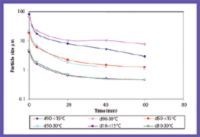
The authors present an overview of various processes for producing nanoparticles and commercial nanoparticle technologies involved in the delivery of poorly water-soluble drugs.

Cell-Grown Vaccine Protects Against Avian Flu Virus

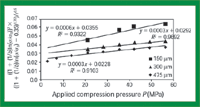
Although physicochemical preformulation screening is practised universally within the pharmaceutical industry, physicomechanical screening is applied to a lesser extent and often only where a problem exists.

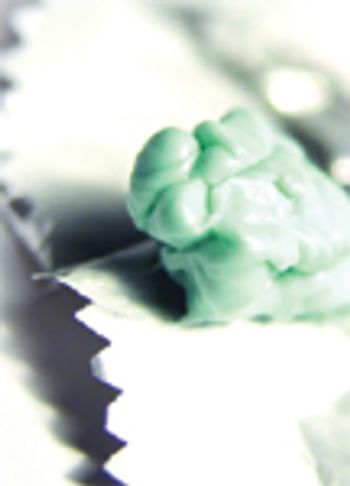
Chewing gum is being developed by Generex as an alternative buccal drug delivery method of metformin for treating diabetes. Results from a small clinical trial, which compared pharmacokinetic profiles of metformin gum with its traditional tablet form, suggest that the gum could additionally avoid the significant adverse gastrointestinal side-effects, including diarrhoea and nausea/vomiting, often accompanying the use of metformin tablets. Given that approximately 30% of metformin users experience such unwanted effects, the gum version could improve patient compliance.


Though dissolution testing has been under scrutiny, it is still a powerful test method.

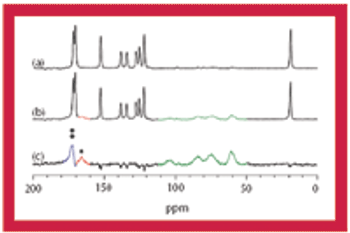
This article discusses the advantages and disadvantages of using solid-state NMR spectroscopy for the analysis of pharmaceutical solids.

Sanofi Pasteur and BD Team Up to Produce Microneedle Vaccines

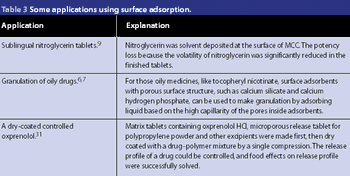
Applications of adsorption of small drug particles at the surface of large excipients were introduced, and different factors affecting adsorption process were discussed and summarized. Several examples of adsorbing drugs to excipients to increase dissolution rate were exhibited in this article.

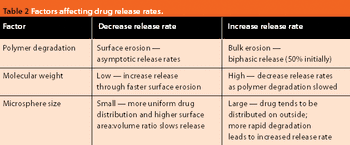
Drug delivery systems using biocompatible polymers allow controlled release of therapeutics, addressing many of the challenges of conventional administration. Polymer microspheres are attractive delivery systems, having a wide application in numerous therapeutic indications. This article reviews the current use and trends for polymer microspheres, and compares production methods and polymer characteristics.

It's time for the pharmaceutical industry to consider electronic innovations as part of their life cycle management strategies.

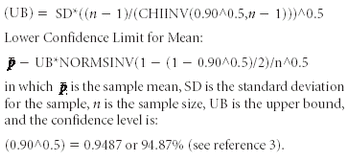
Using the Bergum Method and the MS Excel software program, the author determines the probability of passing the USP dissolution test.

FDA Sees Hike in Combination Product Applications

Novartis Pharma and Ono Pharmaceutical have signed an agreement to codevelop and co market...

Researchers at Johns Hopkins University (Baltimore, MD, USA) have devised a self-assembling cube-shaped perforated container...

SEC Loosens Revenue-Recognition Rules for Vaccine Stockpile Participants

NIAID Boosts Vaccine Innovation but Draws Controversy

FDA Warns Consumers Against Unapproved, Contaminated 'Miracle II Neutralizer'

The attraction of nasal administered therapeutic agents is obvious, including faster onset of action, increased compliance and avoiding degradation during first pass metabolism.

The previous studies on the incorporation of glyceryl monostearate into pellets by extrusion/spheronization has been extended to include a range of grades of this material plus a mixed medium chain partial glyceride and two glycerol esters of hydrogenated natural glycerides as described in this article.

All pharmaceutical products are formulated to specific dosage forms for drugs to be effectively delivered to patients. Typical pharmaceutical dosage forms include oral tablets, capsules, solutions, suspensions, topical ointments, gels, and solutions, and injections for intravenous (IV), intramuscular (IM), or subcutaneous (SC) administration. In addition, various drug delivery systems have been developed for transdermal, intranasal, and pulmonary deliveries. Different dosage forms require different pharmaceutical technologies and usually present different technical challenges for formulation development.

The pharmaceutical industry handles large volumes of granular materials such as powder blends for tablet production and filled capsules everyday (1, 2). Slight changes in ingredient properties or process operation conditions can have a major effect on a finished product's quality. Given the market and regulatory uncertainties that are commonly associated with drug product development, pharmaceutical companies typically have several drugs in various developmental stages at the same time. Because of this volume, the industry must have computer-based rapid-prototyping tools that can efficiently capture and resolve the technical aspects of drug product development so that companies can confidently make decisions about drug portfolio management and planning (3, 4).

Solid oral drug products are one of the oldest of all manufactured dosage forms (1). Today, the development of an appropriate formulation of drug and excipients and of an effective manufacturing process to create a tablet or capsule is slowly transforming from a practice of applied art to one of applied science. The US Food and Drug Administration supports this change by expecting sponsors of new drug applications to understand, describe, and control materials and processes as well as the risks associated with drug product manufacturing (2). These steps will ensure the consistent production of products that meet their specifications and remain safe and effective during their shelf life.

GSK Study Questions Bioequivalency of Generic Cold Sore Creams