Contract manufacturers serving the biopharmaceutical market add capacity in a bet on renewed growth for biomanufacturing.

Contract manufacturers serving the biopharmaceutical market add capacity in a bet on renewed growth for biomanufacturing.

Bavarian Nordic Sues Acambis for Patent Infringement

Acambis and Bavarian Nordic Vie for Smallpox Vaccine Contract

GSK Releases Flu Vaccine Production Strategies

US Government Orders 2M Doses of Avian Flu Vaccine

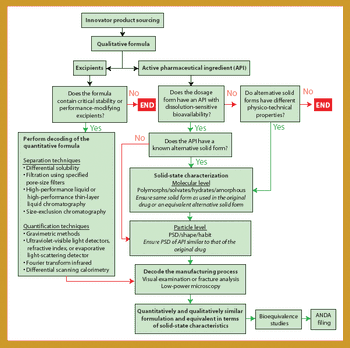
Being the first to gain the most is a fundamental principle in the generics business because several companies compete to create generics of successful products going off patent. For a generics company to maintain revenue growth in a market in which product prices continue to fall, it must secure a continuous flow of new products, with quality and speed to market being key drivers. Thus, generics companies must be highly skilled in product and process development (1), the generics business, and achieving bioequivalence-the most critical development area.

By forming strategic collaborative partnerships with contract research organizations, pharmaceutical companies can take advantage of several strategies for accelerating drug development, maximizing profitability, and extending patent exclusivity.

The aim of this study was to analyse the process of tablet formation and the properties of the final tablets for six different carrageenans. The carrageenans used were based on the basic types of ?-, ?- and ?-carrageenan. Microcrystalline cellulose was used for comparison. Determination of material properties, compression analysis and tablet properties were described. Water content, particle size and morphology, glass transition temperature, and crystallinity were studied. The results show that the carrageenans are predominantly amorphous fibres, which are in the rubbery state during tabletting.

Microbioreactor Array System Boost Cell Culture Capacity

Protein Refolding Technology Improves Yields

Chiron Cuts Supply of Flu Vaccines Made in Germany; Liverpool Plant Under Inspection

First Contraceptive Spray Offers Advantages over the Pill

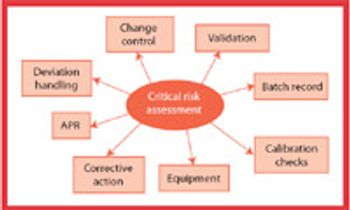
A stepwise, process risk-assessment approach can facilitate the identification and understanding of critical process parameters, quality attributes, and in-process controls. This approach can lead to more use of science- and risk-based regulatory practices to simplify the regulatory requirements for changes to synthetic processes and to support the underlying quality systems that ensure compliance.

Can macromolecular processes learn from small-molecule experience? Burdened by exploding bioreactor productivity, architects of downstream bioseparation technology are looking into the drug industry's past for inspiration, while small-molecule companies adopt techniques pioneered by biotechnology. (The first of three articles on the current state of separations.)

Genentech Anticipates Full-Capacity Manufacturing

Molding Technique Improves Nanoparticle Production

FDA Posts Q5E Biotech and Biological Products Comparability Guideline

Development Collaboration for Ophthalmic Drugs Could Eliminate Injections

Self-Assembly Nanotechnology Improves Microencapsulation

Once considered mainly an afterthought in a company's lifecycle-management strategy, controlled-release dosage forms are now positioned at the forefront of many formulation strategies. In contrast to drug discovery, formulation work focuses not only on the intricacies of the active pharmaceutical ingredient (API), but also on fine-tuning the excipients, the release profile, and the delivery mechanism to provide optimal therapeutic benefit. Because of their wide range of applications and functionalities, especially in controlled-release therapies, polymers are among the most widely used excipients.

Wet granulation is a size-enlargement process in which a liquid is used to achieve the agglomeration of solid particles. Agglomeration improves particles' tableting properties by rendering them free-flowing, nonsegregating, and suitable for compression (1).

Bioadhesive films cast from aqueous blends of PMVE/MA have diverse uses, such as a means of establishing an electrically conducting interface for bioelectrodes and as an adhesive drug delivery matrix.

HR-US is a nondestructive technique with enormous potential for the analysis of materials and formulations used in the pharmaceutical industry.

This high quality of pellet roundness is surprising in view of the high extrusion forces required to extrude the wet masses.

New Excipient Guidance Doesn?t Fill Regulatory Gap