

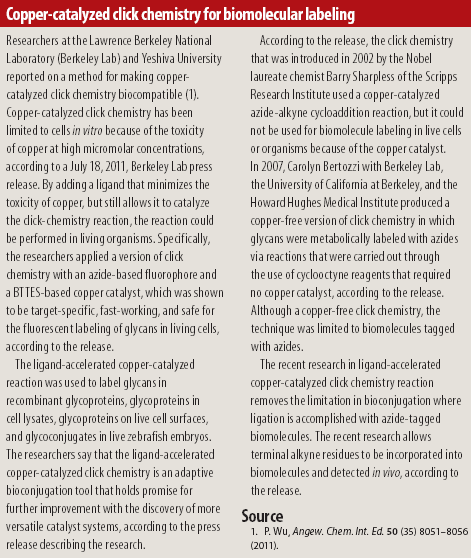

Novartis AG and Novartis Pharmaceuticals Corporation have been focusing research efforts on rare diseases since the company was established in 1996.
Novartis AG and Novartis Pharmaceuticals Corporation have been focusing research efforts on rare diseases since the company was established in 1996.
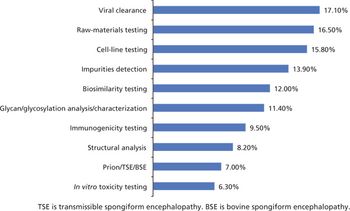
Biosimilar manufacturers need better expression systems and analytical tools to compete.
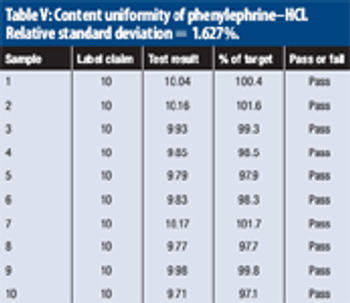
The study evaluates near-infrared analysis of tablets nominally containing 4 mg of chlorpheniramine maleate and 10 mg of phenylephrine hydrochloride per dose.

The authors describe the operational qualification of test accuracy with regard to temperature drift using a thermal-compensation algorithm on several freeze dryers.
EMA released two concept papers for consultation that address the need to revise existing guidelines on biosimilar medicines and influenza vaccines.
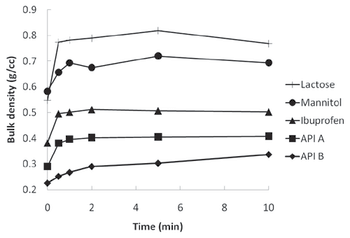
The authors experiment with a resonant acoustic mixer as a method for dry powder coating.
Average deal size and amounts invested increased in the second quarter, but totals trail funding of last year.
AAPS Global Health Focus Group's Kishor M. Wasan discusses new initiatives.

The authors examine risk management relating to the quality issues of clinical-trial materials and discuss areas that would benefit from additional consideration and harmonization.

Could oral absorption-enhancing technologies change the shape of protein delivery?

The authors describe the concept of the limiting discriminatory the limiting discriminatory threshold (LDT) as an objective means of evaluating the inherent quality requirement of a large-sample content-uniformity test.

A Q&A with Rao Tatapudy, vice-president of scientific affairs at Catalent, on recent industry trends.

Manufacturers fund research and reduce prices to tackle diseases.

The global excipients market shows moderate growth, increased consolidation, and expansion activity in emerging markets and select product areas.
Equipment and Processing Report
In a 2004 guidance, FDA says that the "use of redundant sterilizing filters should be considered in many cases." But not all manufacturers agree on what redundant filtration is.
Representatives from FDA, the Generic Pharmaceutical Association, the European Fine Chemicals Group, and a task force from the Society of Chemical Manufacturers and Affiliates are nearing completion of draft legislation for the Generic Drug User Fee Act.

Powder Systems Ltd's (PSL's) new GFD™ isolator combines the latest innovation to provide a high containment lab scale filtration and drying solution with the same reliability and benefits as PSL high containment production size filter dryers.
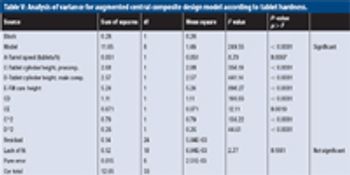
The author prepared and analyzed a detailed design of experiments for the manufacture of a simple tablet formulation. The aim was to test whether tablet hardness and weight could be controlled during the compression process by adjusting certain machine parameters.

A Q&A with John Plachetka, chair, president, and CEO of POZEN, on recent industry trends.

The EU debt crisis portends of possible negative repercussions for the dose CMO industry.

Might European officials reverse their position on acceptable production methods?
Reauthorization of pediatric exclusivity provisions looms in 2012 and debates begin anew.

International Federation of Pharmaceutical Manufacturers and Associations takes global action to improve public health.
Researchers at MIT and Harvard University report on new methods for producing microscale hydrogels.
Pharmaceutical Technology Europe
Elham Blouet from Roquette explains the importance of carbohydrates for injection and the challenges in this niche market.