



Myth versus Reality: What does Q10 implementation really mean for my company?

Myth versus Reality: What does Q10 implementation really mean for my company?
A new book explains process analytical technology, drug stability, and quality.
Process designs and control strategies can be improved by adopting a risk-based approach to product quality. The author describes how this approach can be applied to spray-drying operations.

QbD, PAT, design space, what's it all about? This seems to be a common industry response to FDA's directional push.
Here's a look at some of the most interesting and thematic responses you-our readers-provided for Pharmaceutical Technology's anniversary survey of industry advances and directions.

Signature authentication technology has evolved to become a stong tool for improving confidence in verification.
San Juan, PR (Apr. 25)-Regulatory and quality issues were prominent discussion topics at this year?s ExcipientFest conference and exhibition.
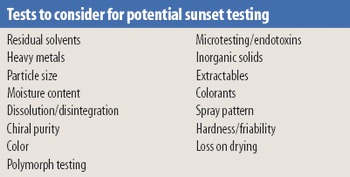
The concept of Acceptable Analytical Practices (AAPs) was developed by the Analytical Technical Group of the Pharmaceutical Research and Manufacturers of America to share information about how the pharmaceutical industry has implemented chemistry, manufacturing, and controls and quality guidances of the International Conference on Harmonization and worldwide regulatory authorities. The AAP process identifies and addresses critical issues in which guidance is lacking, ambiguous, or contradictory. AAPs were designed to provide a forum where one could learn from the experience of experts in pharmaceutical analysis and enhance the understanding of analytical practices that reflect good science and sound regulatory compliance. This article summarizes the discussion points from a meeting regarding the Justification of Specifications topic.

This article considers the distinction among the terms qualification, validation, and verification in the context of pharmacopeial usage.A recommendation for a standardized usage of the terms validation and verification is provided,and general requirements for validation and verification activities are given.The article also emphasizes the importance of knowing when validation or verification is necessary relative to the use of a method to satisfy pharmacopeial article requirements (for which a monograph exists in the pharmacopeia) or for nonpharmacopeial use.
The authors describe the methods by which precise analyses of stable-isotopic abundances can be used in security and forensic applications for pharmaceutical materials. These methods include product and process authentication of raw materials, pharmaceutical intermediates, drug substances, formulated drug products, and synthetic pathways. Collectively, these methods can be used to investigate and mitigate patent infringement. In the future, more complete examples will be presented containing full isotopic results and the application of the methods described in this article.
As technology for impurity analysis improves, scientists are gaining better information and asking for more regulatory guidance.
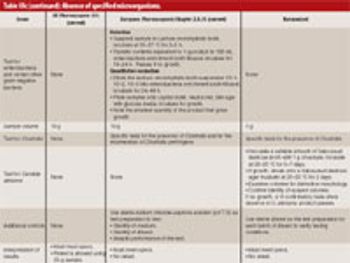
The US Pharmacopeia (USP), the Japanese Pharmacopoeia, and the European Pharmacopoeia "Microbial Limits Tests" are in the final stages of harmonization. The harmonized USP chapters are slated for implementation in 2009. This article describes the harmonized USP Chapters <61> "Microbial Enumeration," <62> "Absence of Specified Microorganisms," and <1111> "Microbiological Attributes of Nonsterile Pharmaceutical Products," and suggests they will likely require some revalidation of existing methodologies. Companies should put plans in place immediately for this work and show consistent progress towards this goal.

We really knew what we were doing-until we opened the column for a routine repacking.
ePT--the Electronic Newsletter of Pharmaceutical Technology
London (Nov. 22)-The European Medicines Agency reports a defect in some vials of Herceptin (trastuzumab), the anticancer treatment by Roche, which have been distributed in Europe. As a result, The EMEA's Committee for Medicinal Products for Human Use outlined a plan, formulated in conjunction with Roche, for the visually reinspecting and replacing defective vials.
ePT--the Electronic Newsletter of Pharmaceutical Technology
Over-the-counter drug maker Perrigo Company issued a voluntary recall of certain lots of store-brand acetaminophen 500-mg caplets that could contain trace amounts of metal particulate. Approximately 11 million bottles of acetaminophen are affected by the recall.
ePT--the Electronic Newsletter of Pharmaceutical Technology
Mystic, CT (Oct. 26)-Kenneth G. Chapman died at his home here on Oct. 26. He was 79. The cause was pancreatic cancer
ePT--the Electronic Newsletter of Pharmaceutical Technology
AAPS, San Antonio (Oct. 31)-Industry and regulatory agency concerns over process variability have prompted both groups to take a closer look at analytical method transfer processes.
ePT--the Electronic Newsletter of Pharmaceutical Technology
Rockville, MD (Oct. 2)-The US Food and Drug Administration has issued its final Guidance for Industry: Quality Systems Approach to Pharmaceutical CGMP Regulations.
Washington, DC (Sept. 12)-The Office of New Drug Quality Assessment (ONDQA) in the Center for Drug Evaluation and Research (CDER) has approved one new drug application (NDA) under its CMC Pilot Program and has two more applications are under review. The pilot was established last year to provide an opportunity for FDA and industry to explore strategies for including Quality by Design (QbD) principles and process analytical technology approaches in regulatory submissions, explained ONDQA deputy director Chi-wan Chen at the PDA-FDA Joint Regulatory Conference here
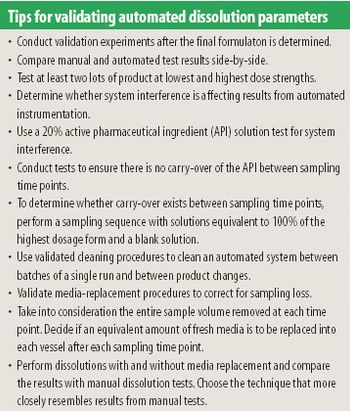
As the pace of product development accelerates, the approach to dissolution-method development must advance beyond a manual method and an assay. A natural progression of the method-development process must include the transfer of the manual method onto automated instrumentation.
Microsoft Corporation (Redmond, WA) announced the winners of the Microsoft Pharmaceuticals and Life Sciences Innovation Awards 2006 at this year?s meeting of the Drug Information Association in Philadelphia, Pennsylvania. A four-person panel of industry experts selected winners for the innovative use of Microsoft products in pharmaceutical and life sciences business processes and practices.

I always suspected that our purchasing manager had agreed to this just to save money . . .

Guidance for reducing the risk of dissolved ozone measurement and addresses proper installation, calibration, and verification to ensure the best possible answers from dissolved ozone analysis.

Though dissolution testing has been under scrutiny, it is still a powerful test method.
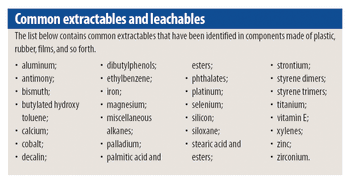
Extractable and leachable issues should be resolved early in the drug manufacturing process. Open communication is imperative for a successful study.