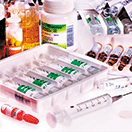
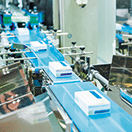

Regulations and industry guidelines focus on ensuring excipient safety by specifying risk assessments and shared responsibility.
Regulations and industry guidelines focus on ensuring excipient safety by specifying risk assessments and shared responsibility.

While more companies are embracing taggants, researchers are developing new technologies that will be extremely difficult to reproduce.

Chemical engineers and chemists each bring unique skills to API process development and optimization. Success depends on their close collaboration, at both sponsor and CDMO facilities.

The revised Annex 1 on sterile manufacturing includes incorrect and ambiguous statements that must be fixed before implementation.
Lonza Pharma & Biotech's's Modular Automated Sampling Technology (MAST) platform, which allows for the collection of up to 10 sterile sample sources for automated analysis in multiple analytical devices, won the CPhI Pharma Award 2017 for Excellence in Pharma: Bioprocessing.
The company has expanded its voluntary nationwide recall to include a second lot of Nexterone injection. This recall is due to particulate matter found in the product.
Pharmaceutical Technology's In the Lab eNewsletter
In a roundtable Q&A with biopharma executives, the vulnerability and challenges of dealing with extractables and leachables in single-use bioreactor bags are explored.
The company is voluntarily recalling product because of glass particles found in vials.
PharMEDium Services, LLC voluntarily recalled some lots of product because of a lack of sterility assurance.
Enterprise-wide processes, procedures, and systems are the keys to data integrity and peace of mind, according to Siegfried Schmitt, PhD, principal consultant at PAREXEL.

Process validation is an extension of biologics development processes.

A new algorithm uses a statistical approach to critical process parameter assessment, allowing for faster, more consistent, and less subjective critical process parameter quantification, visualization, and documentation.
The recall was initiated due to a product complaint in which white particulate matter, identified as mold, was discovered in a flexible bag from one batch.
The company is voluntarily recalling one lot of Pantoprazole Sodium for Injection 40 mg per vial because of glass particles found in a vial.
FDA sent a warning letter to Deserving Health International Corp. after inspectors found CGMP violations including failure to prevent microbiological contamination.
An increasing number of warning letters shows that FDA is observing more problems with pharmaceutical contract manufacturing.
SOPs need to reflect a company’s specific manufacturing or other operations, says Susan Schniepp, distinguished fellow at Regulatory Compliance Associates.

Rinse sample analysis or visual inspection are risk-based approaches that can be correlated to surface cleanliness to replace surface sampling in a biopharmaceutical equipment cleaning process.
The company is voluntarily recalling one lot of NEXTERONE 150 mg/100 mL Premixed Injection because of particulate matter found in the solution.
Investing in a single source enterprise-wide LMS to fuel risk management and mitigation offers multi-dimensional return on investment.
FDA is exploring ways to keep branded drug companies from using REMS to block the development of generic drugs.
The level of formality in change control may be holding back your SOP progress, according to Siegfried Schmitt, principal consultant at PAREXEL.
The revised Akers-Agalloco aseptic risk assessment and mitigation method includes two sub-methods that can be used independently for risk assessment.
Creating a quality culture can prevent the costs and challenges associated with receiving a consent decree.

In Part I of this article series, the regression control chart method for identifying out-of-trend data in pharmaceutical stability studies is investigated, and an improved approach is suggested.