
Multiple methods are required for detecting and removing protein impurities.

Cynthia A. Challener is a contributing editor to Pharmaceutical Technology.
Multiple methods are required for detecting and removing protein impurities.

PTSM: Pharmaceutical Technology Sourcing and Management
Research efforts around the world are demonstrating that the application of flow chemistry for small-molecule API synthesis.

Recent chiral advances demonstrate promise for API synthesis.

PTSM: Pharmaceutical Technology Sourcing and Management
Effective harvesting and purification processes play an essential role in ensuring that biopharmaceutical manufacturing processes provide biologic drug substances with uniform and consistent properties.
Application of flow chemistry for small-molecule API synthesis continues to expand thanks to research efforts.
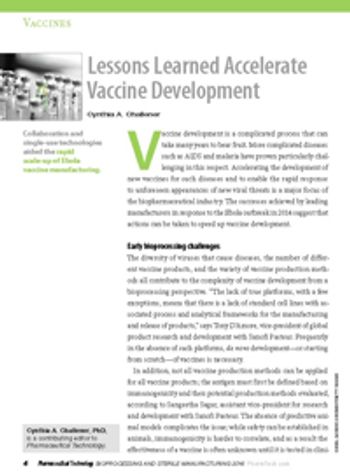
Collaboration and single-use technologies aided the rapid scale-up of Ebola vaccine manufacturing
PTSM: Pharmaceutical Technology Sourcing and Management
The production of antibody-drug conjugates requires biopharmaceutical and chemical manufacturing, and conjugation capabilities.
Bioprocess operations-from cell line selection to final filtration-can influence the consistency and purity of biologic drug substances.

PTSM: Pharmaceutical Technology Sourcing and Management
Determining the appropriate amount and type of screening challenges drug developers when identifying relevant crystalline forms.
Manufacturing highly toxic compounds in a biopharmaceutical environment tests equipment and systems.
Gauging the adequate level and type of screening is the challenge when identifying relevant crystalline forms.

PTSM: Pharmaceutical Technology Sourcing and Management
Scale-down modeling accelerates the development of downstream biopharma manufacturing processes.

PTSM: Pharmaceutical Technology Sourcing and Management
Hazardous reagents can prove to be faster, simpler, cheaper, and greener.
PTSM: Pharmaceutical Technology Sourcing and Management
Nanoscale catalysts and engineered nanoparticles show promise for API synthesis and delivery.
Scale-down modeling is instrumental in supporting the development of downstream biopharma manufacturing processes.
Hazardous reagents can simplify processes and provide higher yields and purities.

Time and sensitivity are essential for analytical technologies in all phases of biopharma development.

PTSM: Pharmaceutical Technology Sourcing and Management
Despite fewer FDA approvals in 2015, the prospects for the API market in 2016 are strong.
Nanoscale catalysts and engineered nanoparticles may have a big impact on small-molecule pharmaceuticals.
A strong API market is expected in 2016 despite fewer new drug approvals.
PTSM: Pharmaceutical Technology Sourcing and Management
Multi-component coupling reactions for the generation of heterocycles in fewer steps reduced processing times, cost, and waste are attracting interest.

PTSM: Pharmaceutical Technology Sourcing and Management
In the ongoing search for better fluorinating reagents, solid reagents and new coupling reactions are showing promise.
Efficient syntheses are possible using multi-component and cross-dehydrogenative, heteroaromatic C–H silylation reactions
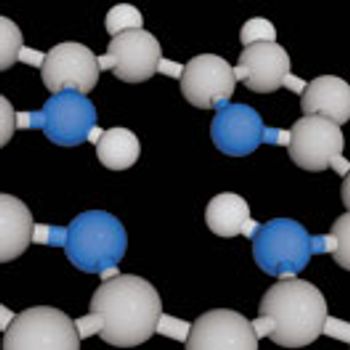
Efficient syntheses are possible using multi-component and cross-dehydrogenative, heteroaromatic C-H silylation reactions.

PTSM: Pharmaceutical Technology Sourcing and Management
The use of low-temperature chemistry can often lead to more direct, cost-effective routes to sophisticated pharmaceutical compounds.
Safer solid reagents and new coupling chemistry are important developments.
More complex drug candidates require more specialized and selective chemistry.
The complex task of stabilizing proteins is made more challenging due to the limited number of approved excipients.

PTSM: Pharmaceutical Technology Sourcing and Management
Early adopters look to speed up the use of continuous API manufacturing, but lack of expertise hinders adoption of continuous API synthesis.

Potential for improved product quality and cost/time savings is reviving interest in perfusion technology.