



Pharmaceutical Technology Europe
Highly potent APIs (HPAPIs) represent a growing area of interest for the pharma industry. Mark Griffiths, CEO of Carbogen Amcis AG, explains why.
Advancements in personalized medicine and other innovations are transforming the way dosage forms are viewed.

Novel genetic engineering technologies are transforming the design and manufacture of bispecific antibodies, which are emerging as a promising new class of biologics.

Pharmaceutical Technology Europe
Highly potent APIs (HPAPIs) represent a growing area of interest for the pharma industry. Mark Griffiths, CEO of Carbogen Amcis AG, explains why.

Pharmaceutical Technology Europe
Henrik Schwartzbach, senior process technologist at GEA Niro, explins why spray drying is seeing increased uptake in the pharma industry.
Pharmaceutical Technology Europe
Recently, there have been many innovations in the latest techniques and technologies in API purification. In particular, the trend to single-use systems has had a significant impact on processes.
FDA published a draft guidance that lists recommendations to follow, data to provide, and criteria to meet and describe in new drug applications and abbreviated new drug applications for scored tablets.
Equipment and Processing Report
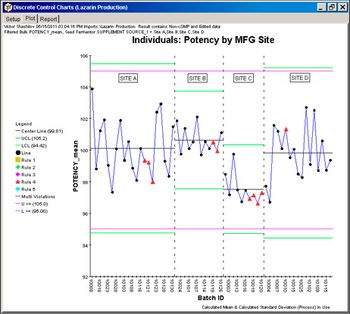
Using information technology tools to enhance process understanding helps reduce variability that can affect speed to market.
Since the passage of the BPCI Act in 2009, manufacturers have been waiting for guidance from FDA on what that approval process will look like.

Xevo TQD provides ultimate consistency between analyses; instrument to instrument, lab to lab; both the advanced technology of the ACQUITY UPLC System and the robust universal ion source architecture on the Xevo TQD guarantee flexibility and dependability.

Are biosimilars the next big thing or just the next big bubble?

A path to personalized medicines creates a new paradigm for development and manufacturing.
FDA Approves the Influenza Vaccine Formulation for the 2011-2012 Flu Season.
A bill introduced by Senators Scott Brown (R-MA), Ron Wyden (D-OR), and John McCain (R-AZ) on July 13, 2011, aims to encourage states to reduce Medicaid spending by offering financial incentives to substitute generic drugs for branded ones where possible.
The performance of biotechnology venture capital and investment is lackluster at best.

The solid form of an API plays a crucial role in drug quality, and advancing methods for screening, detection, and characterization is key.
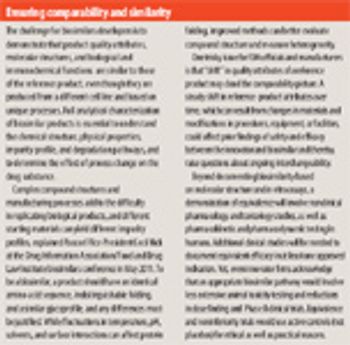
Follow-on versions of complex biologics require extensive expertise in development and regulatory procedures.
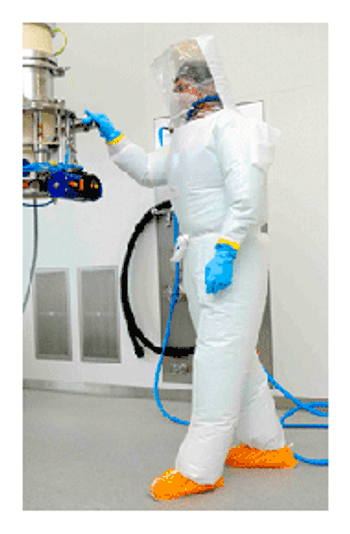
A technical leader in solid dosage forms Pfizer CentreSource provides analytical, technical, regulatory, developmental, manufacturing and packaging support that spans the specialized realm of highly potent solid oral dose drug products.
Merck and Hanwha Chemical have formed an exclusive global agreement to develop and a commercialize a biosimilar of Enbrel, a drug to treat moderate to severe plaque psoriasis, psoriatic arthritis, and moderate to severe rheumatoid arthritis.
Pharmaceutical Technology Europe
Effective containment in API and drug-product manufacturing encompasses a variety of process, equipment, and operational issues.

More sophisticated biological expression systems expand the functionality of the traditional systems for protein synthesis.
Academic–industry partnerships are increasingly important in biopharmaceutical innovation.
FDA weighs multiple views regarding the Biologics Price Competition and Innovation Act.
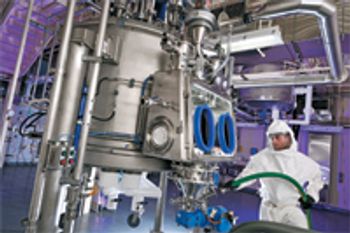
Effective containment in API and drug-product manufacturing encompasses a variety of process, equipment, and operational issues.
Equipment and Processing Report
Filling active ingredients directly into capsules is probably the quickest option for entering clinical trials. This case study compares manual and automated methods of capsule filling.
FDA is asking for input on the development of a user-fee program for biosimilar and interchangeable biological product applications.
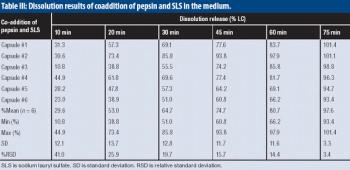
The authors develop a pratical approach to avoid unwanted interactions between pepsin and SLS in dissolution Tier II tests.

Emerging methods could provide alternative ways of producing inhalable drug particles.