

New Excipient Guidance Doesn?t Fill Regulatory Gap
New Excipient Guidance Doesn?t Fill Regulatory Gap
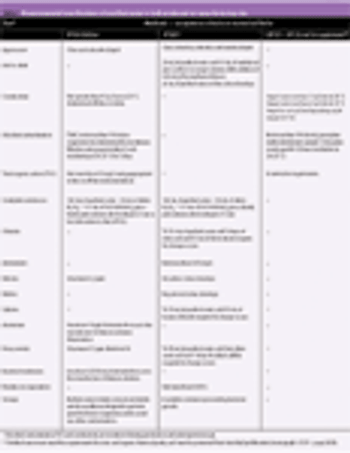
IPEC-Americas has just completed a major update to its significant change guideline to address current issues in the manufacture of excipient ingredients and to assist manufacturers in developing an impurity profile.
Pharmaceutical Science & Technology Innovations
Pharmaceutical Technology Europe
A harmonized global specification is possible providing that the procedures and acceptance criteria defined are acceptable to regulatory authorities in all regions.
Added functionality excipients facilitate the development of novel drug delivery methods and improve processing techniques.
The author suggests that an excipient's functionality can only be determined in the context of a specific formulation and manufacturing process.
Synthetic excipients frequently offer advantages over all-natural compounds.
Pharmaceutical Technology Europe
Dry powder inhalers are a well-accepted dosage form for pulmonary drug delivery and a wide variety are either currently available or in development. This article examines a premetered, capsule-based multidose inhaler for which different qualities of a-lactose monohydrate were screened.

Pharmaceutical Technology Europe
The bioavailability of some insoluble drugs is enhanced when they are dissolved in the solubilizing agent macrogol 400, although conventional hard capsules cannot tolerate the agent. This article investigates a PVA copolymer, which has been developed by the authors, examining its properties and its suitability as a material in capsule formulations.
The authors examine the development and performance of coprocessed excipients, including testing them for flowability, compressibility, amd dilution potential.
The influence of light on the rate of moisture gain was investigated in 36 drug substances and 18 excipients.
One of the greatest challenges facing biopharmaceutical manufacturers has been the primary recovery of recombinant materials from transgenic sources. As an alternative to existing methods, vibrating membrane technology, which is widely used in food and beverage processing, recently has been adapted to biopharmaceutical applications involving transgenic biosolutions.

Pharmaceutical Technology Europe
Erythritol is a bulk sweetener polyol that is suitable for a variety of reduced-calorie and sugar-free foods. It has been part of the human diet for thousands of years because of its presence in foods such as fruit, mushrooms and fermentation-derived products including wine, soy sauce and cheese. This article investigates the properties of erythritol and describes how it can be used as a pharmaceutical excipient.
Pharmaceutical science & technology news.
The authors investigated the moisture gain of products containing ethambutol that were packaged in strip and blister packs as well as unpackaged formulations.
As parenteral drug delivery becomes more complex and sophisticated, excipients that can facilitate drug (or gene) delivery to specific therapeutic targets will be required. An overwhelming majority of these excipients are derived from natural sources.

Pharmaceutical Technology Europe
The tabletting properties of a new coprocessed excipient for direct compression were compared with a physical mixture of its components (separately and with drugs) and the individual constituents. The compaction properties were also investigated. Results indicated that the new excipient has excellent flow properties and demonstrates enhanced compressibility.
Pharmaceutical Technology Europe
Medicines and excipients are inseparable, with few exceptions - one cannot exist without the other. The Pharmaceutical Quality Group and other international bodies have developed good manufacturing practice (GMP) standards and guidelines to facilitate the effective supply of excipients. This article discusses the definition and significance of excipients, and highlights the importance of implementing the correct excipient manufacturing controls and standards.
Pharmaceutical Technology Europe
The aim of this work was to investigate the compactibility, compressibility and drug release behaviour of different fractions of a commercially available ethyl cellulose.
In this study, the authors investigated the compression behavior of excipients with different molecular weights using the modified Fraser-Suzuki function and correlated the S-parameter of this function with Young's modulus.

Pharmaceutical Technology Europe
Using melt extrusion to prepare glass solutions of poorly water-soluble drugs with hydrophilic excipients offers an exciting and advantageous alternative to existing formulation methods such as spray-drying and co-melting. Investigating potential methods to increase water solubility begins early in drug development. Techniques described in this paper show how only a small quantity of drug can be used to determine its suitability for melt extrusion, allowing the method to be considered at the same time as salt screening and particle size reduction work, and could speed up the formulation process.
A new set of proposed GMP standards for excipents may present more problems than benefits.
A global drug master file system may pave the way for faster qualifications of new excipients and the industry's acceptance of their use in drug therapies.
The authors discuss the physiocomechanical characteristics of three commonly used pharmaceutical excipients and describe the effects of variables on their physiocomechanical stability.
To aid the fomulation scientist in selecting the optimal excipients for the preparation of vaginal products, the authors have compiled a list of all presently available vaginal excipients, including their functional categories and regulatory status.