

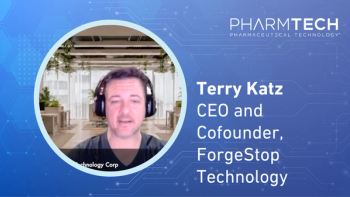
Terry Katz, CEO and co-founder of ForgeStop Technology Corporation, explains how the company’s product is worth the investment by protecting products and patients.
Terry Katz, CEO and co-founder of ForgeStop Technology Corporation, explains how the company’s product is worth the investment by protecting products and patients.
Terry Katz, CEO and co-founder of ForgeStop Technology Corporation, explains how its connected technology can enhance anticounterfeiting and how data are handled within the product.
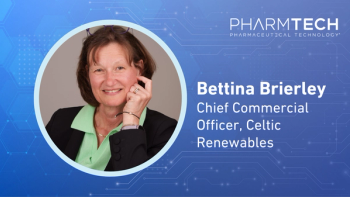
Celtic Renewables won the CPHI Award for Sustainable Pharma Excellence for its green chemicals used in pharmaceutical manufacturing. Bettina Brierley, chief commercial officer, talks about the adoption, capacity, and pricing of biosolvents.
Terry Katz, CEO and cofounder of ForgeStop Technology Corporation, explains the company’s CPHI Award-winning connected product technology and how it helps to combat drug counterfeiting.
Bettina Brierley, chief commercial officer at Celtic Renewables, discusses commercialization of biosolvents for pharmaceutical manufacturing.
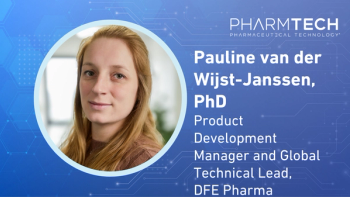
CPHI Award winner, Pauline van der Wijst-Janssen, PhD, product development manager and global technical lead at DFE Pharma, explains excipient variability and excipients’ role in continuous manufacturing.
Pauline van der Wijst-Janssen, PhD, of DFE Pharma, won the CPHI Pharma Award for Future Leader. In this interview with PharmTech, she provides advice for scientists looking to advance to leadership roles.
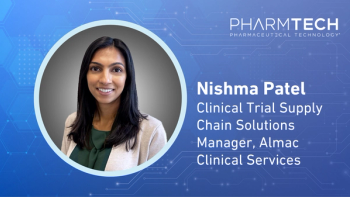
Almac Clinical Services’ clinical supply strategy won the 2026 CPHI Award for Supply Chain Excellence. Nishma Patel, supply chain solutions manager, explains how her team managed the study’s strict −80 °C handling requirement, quality release, and site readiness, and how the Almac Adapt approach can apply beyond this program.
Almac Clinical Services’ clinical supply strategy won the 2026 CPHI Award for Supply Chain Excellence. Nishma Patel, supply chain solutions manager, explains the benefits and challenges of the company’s just-in-time manufacturing solution.
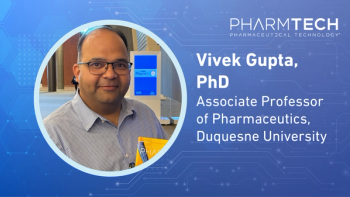
Vivek Gupta of Duquesne University explains at AAPS PharmSci 360 why device decisions can't wait and why excipient makers must test beyond drug molecules.
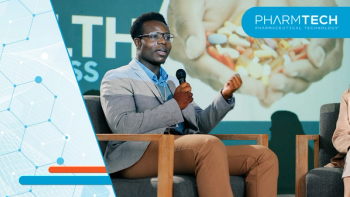
Industry subject matter experts spoke about the challenges of turning complex molecules into medicines patients can reliably use.

The pharmaceutical supply chain is a complex system with high stakes. USP provides insights on how it is helping industry navigate global disruptions and procurement issues.
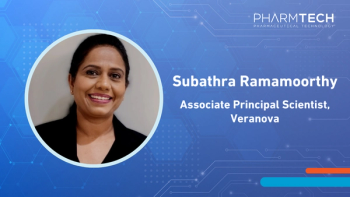
Impurity deficiencies in submissions are remarkably consistent. Subathra Ramamoorthy, Veranova, explains how to catch them before agency filing.
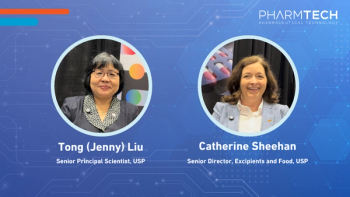
USP’s Sheehan and Liu talk at AAPS PharmSci 360 abou getting novel excipients past the monograph hurdle through early engagement with FDA.
CDMOs announced expansions, exhibitors showcased automated equipment, and supply chain strategy discussions were a focus at CPHI Milan 2026.
Subathra Ramamoorthy, Veranova, on how forced degradation and trace impurity profiling in potent APIs shape regulator-ready analytical methods.
Subathra Ramamoorthy, Veranova, on when to escalate to structural elucidation and pair orthogonal techniques when characterizing an impurity.
Manish Baviskar, Hubot CDMO, on ALCOA++ data integrity, model version change control, continuous monitoring, and human sign-off.
Manish Baviskar, Hubot CDMO, explains which AI skills validation engineers need first and why AI model updates must go through GMP change control.
Ron Filler, Drug Development Consultants, explains how USP's 1074 revision brings human-relevant safety science to formulators and excipient makers.
Nitin Kumar Swarnakar, PhD, global application lab manager at BASF, talks about spray drying for drying amorphous solid dispersions and Raman spectroscopy’s role as a quantitative analytical tool.
Ron Filler, Drug Development Consultants, explains how USP's 1074 revision brings human-relevant safety science to formulators and excipient makers.
Nitin Kumar Swarnakar, PhD, global application lab manager at BASF in Tarrytown, spoke with PharmTech at AAPS PharmSci 360 about formulation and characterization challenges for amorphous solid dispersions.
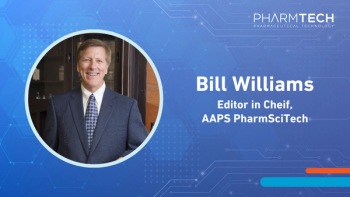
Bill Williams, AAPS, compares KinetiSol and spray drying for amorphous solid dispersions, covering 75% drug loading, pill burden, weakly basic drug release, and process limits.

Vibha Jawa, PhD, chief scientific officer at EpiVax, discusses the limitations of current preclinical testing approaches and how new approach methodologies can strengthen drug development.
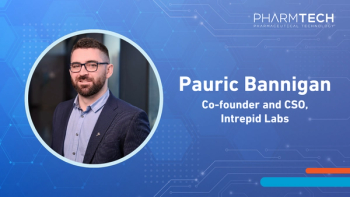
Pauric Bannigan, Intrepid Labs, explains how physics-informed machine learning aids formulation and why regulators still want experimental data.
Vibha Jawa, PhD, chief scientific officer at EpiVax, explains why the need for animal studies varies by modality and what it takes for organ-on-chip and other human-relevant models to replace these studies in IND-enabling toxicology work.
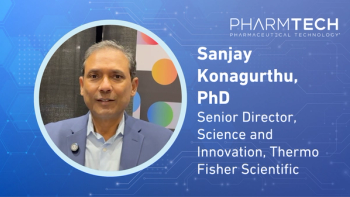
Sanjay Konagurthu, PhD, senior director of Science and Innovation at Thermo Fisher Scientific, explains what teams need to do to ensure the usefulness of AI and what strides have been made with AI in regulatory submissions.
Pauric Bannigan, Intrepid Labs, explains where AI speeds formulation decisions, why data is the bottleneck, and how active learning trains models with far less data.

The new initiative aims to apply traceable AI and science to expand care worldwide by translating discovery into tools that accelerate drug development.